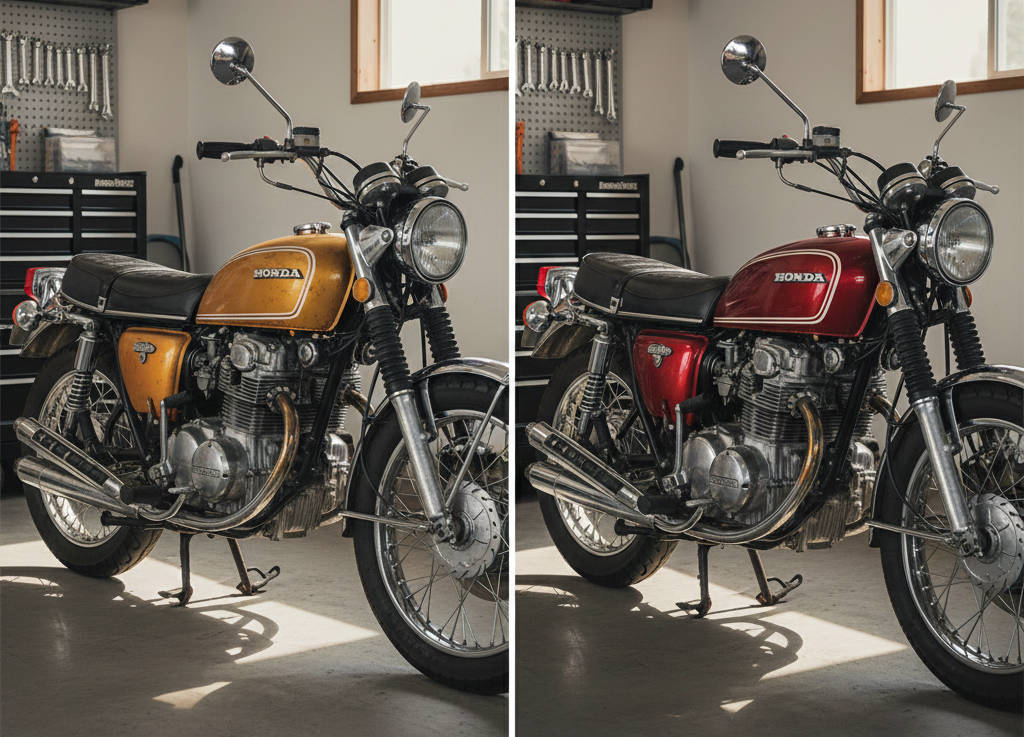
In the world of vintage bikes, “finished” is a relative term. Before you dive into your project, you need to ask yourself a hard question: What do I want the bike to look like when I’m done?
The level of detail you choose will dictate how much time you spend in the garage versus how much time you spend on the road. Generally, vintage projects fall into three “finish” categories.
1. The “Patina” Rider (The Survivor)
This is for the person who loves a bike that tells a story. You aren’t worried about a dent in the tank or some pitting on the chrome. Your goal is mechanical excellence with an aesthetic that says, “I’ve been around since 1974.”
-
The Work: Focus is 90% mechanical. New tires, safe brakes, a tuned engine, and a good coat of wax to preserve the rust and fading.
-
The Pro: You can get on the road quickly and you won’t have a heart attack if a pebble chips the paint.
-
The Con: People will constantly ask you, “When are you going to paint it?”
2. The Clean Restoration (The “Better Than New”)
This is the most common goal. You want a bike that looks like it just rolled off the showroom floor—maybe even better. The frame is powder-coated, the engine cases are scrubbed clean, and the paint is deep and glossy.
-
The Work: A complete “frame-off” teardown. You’ll be spending a lot of time with a wire wheel, a polishing mop, and a paint sprayer.
-
The Pro: It’s a head-turner. You’ll get “thumbs up” at every stoplight.
-
The Con: It’s much more expensive and time-consuming. You’ll spend hours cleaning parts nobody will ever see.
3. The Custom / Cafe Racer (The Reimagining)
Sometimes the “detail” isn’t about restoration, but transformation. You might be cutting the frame, changing the seat, or swapping the handlebars.
-
The Work: This requires fabrication skills. You aren’t just replacing parts; you’re re-engineering the bike.
-
The Pro: The bike is a unique reflection of your style.
-
The Con: It’s very easy to “over-customized” a bike into something that is uncomfortable or hard to sell later.
Why You Must Decide Now
If you want a Patina Rider, you should look for a bike that is mostly complete and original. If you want a Clean Restoration, you can afford to buy a “basket case” because you’re going to replace everything anyway.
The “Mission Creep” Trap The biggest danger in a vintage project is starting a “Patina Rider” and halfway through deciding you want it to be a “Show Bike.” Suddenly, you’re stripping a frame you just put back together. Decide on your “Level of Detail” now, and stick to it!
A Thought for the Reader
There is no wrong answer here. In my opinion, a greasy, reliable ‘rat bike’ that gets ridden 5,000 miles a year is arguably ‘better’ than a perfect museum piece that never leaves the living room. Pick the level of detail that makes you want to ride. For me, I’m a rider not a hider. I like my bikes in great working condition and looking nice, but not so nice that I’m afraid to take them out on the road… but that’s just me! =;-)