
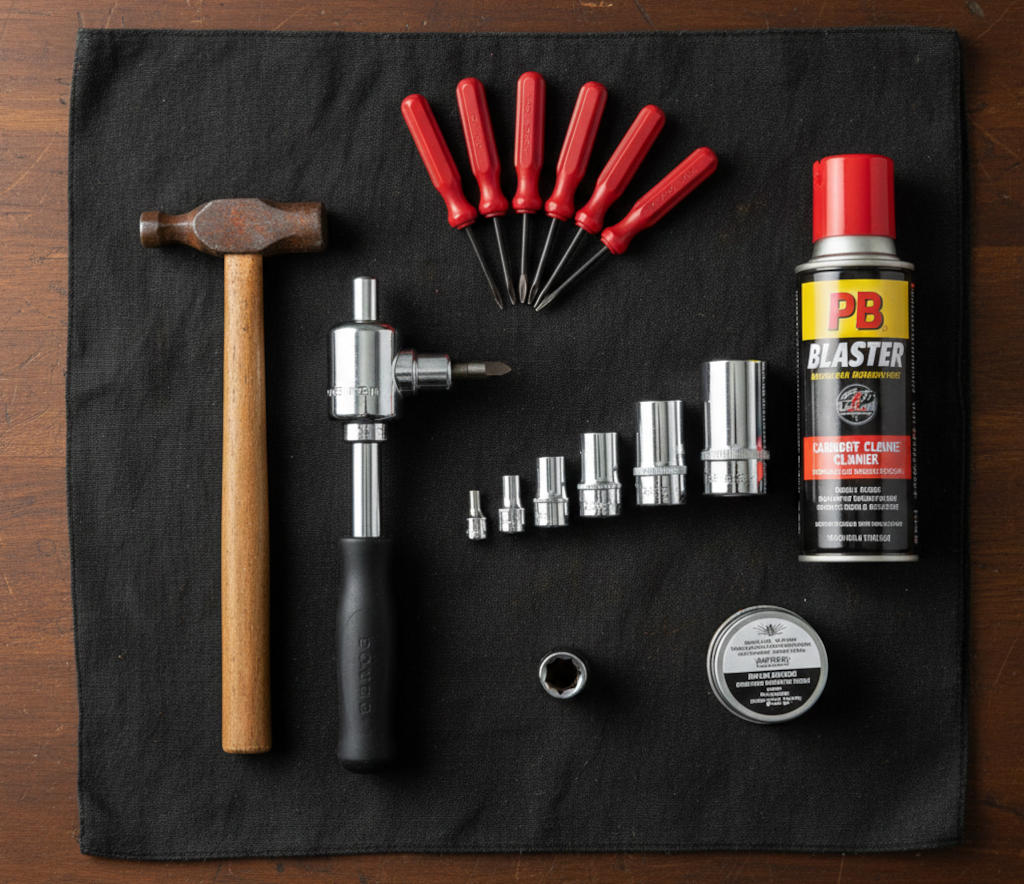
You don’t need a five-figure tool chest to build a vintage bike, but you do need more than a rusty pair of pliers and a butter knife. Vintage bikes have been sitting for decades; their bolts are seized, their screws are soft, and their clearances are tight.
If you’re starting from scratch, here is the essential kit to get the job done without losing your mind (or your skin).
1. The “Secret Weapon”: JIS Screwdrivers
If you are working on a vintage Japanese bike (Honda, Yamaha, Suzuki, Kawasaki), this is the most important thing you will read. Those “Phillips” head screws on your engine cases? They aren’t Phillips. They are JIS (Japanese Industrial Standard). * A standard Phillips screwdriver is designed to “cam out” (slip).
-
A JIS screwdriver is designed to grip tight. Using a Phillips on a stuck JIS screw is a guaranteed way to strip the head. Do yourself a favor and buy a set of JIS drivers immediately.
2. Quality Wrenches & Sockets (The Six-Point Rule)
When dealing with old, soft hardware, avoid 12-point sockets. They only grip the corners of the bolt and are much more likely to round them off.
-
Invest in 6-point sockets. They grip the flats of the bolt head and can handle the extra torque needed to break loose a bolt that hasn’t moved since 1978.
3. Impact Driver (The Hand-Powered Kind)
When a screw is truly stuck, don’t just lean on it. You need a Manual Impact Driver. You hit the back of it with a hammer, and it converts that downward force into a sharp, powerful twisting motion. It is the only way to remove engine case screws without damaging them.
4. Chemicals: Your Liquid Mechanics
On a vintage project, your best friends come in spray cans:
-
Penetrating Oil (PB Blaster/Kroil): Spray this on every bolt 24 hours before you try to turn it.
-
Carburetor Cleaner: You’ll go through more of this than you think.
-
Anti-Seize: Use this on every bolt you put back into the bike so the next person (or future you) can get it out easily.
5. The Specialty Stuff (Rent, Don’t Buy)
As you progress, you’ll need things like a Torque Wrench, a Chain Breaker, or a Compression Tester. Most major auto parts stores will “rent” these to you for free—you pay a deposit, use the tool, and get your money back when you return it.
Pro Tip: If you find yourself needing to buy a tool you’ll only use once, check the forums we talked about in the last step. Often, local enthusiasts will lend you a specialty tool for the price of a six-pack of beer.