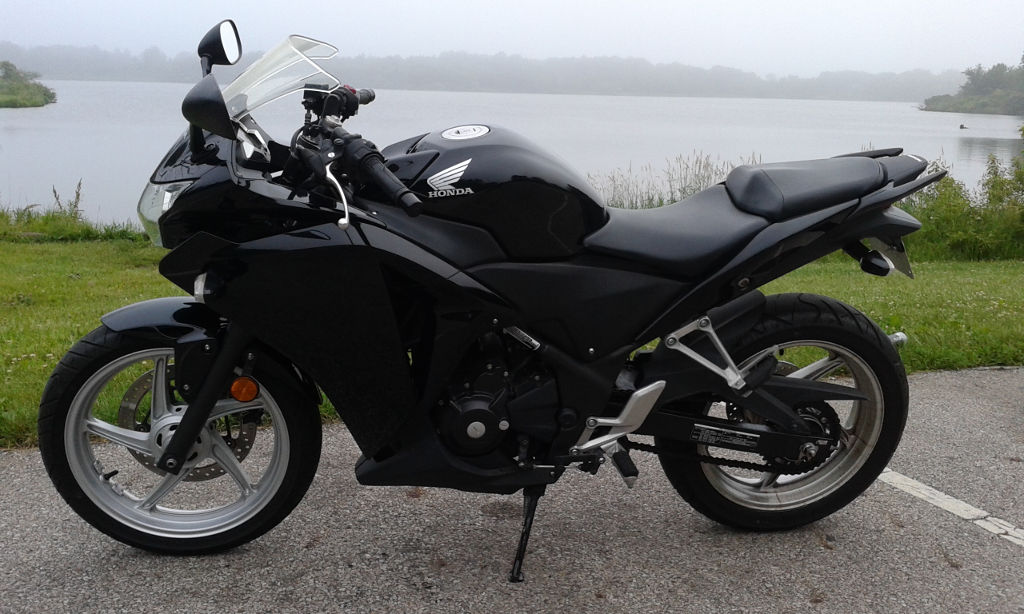
A CBR 250R, a Rainy Road, and Split-Second Physics
We’ve all been there—the “third shift fog.” You’ve finished your night’s work, the sun is just starting to peek over the horizon, and your only goal is your own bed.
Several years ago, I was heading home after a long night shift on my Honda CBR 250R. For some reason, instead of my usual route, I found myself cutting through the heart of the city. The air was damp; a recent rain had left the asphalt with that slick, unforgiving sheen.
I was sitting at a red light on a four-lane main vein, cars tucked in behind me and to my right. When the light turned green, we moved as a pack. That’s when it happened.
The Moment the World Slowed Down
Out of nowhere, a full-size pickup truck pulled out, broadsiding our lane of travel.
I squeezed the brakes, but I knew immediately: the math wasn’t adding up. Between the wet road and the limited contact patch of the CBR’s tires, I wasn’t going to stop in time. Behind me, the sickening skree of sliding tires told me the cars behind me weren’t going to make it either.
If I stayed the course, I was going to be the meat in a metal sandwich.
Then, everything dropped into slow motion. My brain stopped panicking and started calculating. I didn’t “think” about what to do; my hands just did it. I released the front brake slightly and swerved into the continuous turn lane to my left, just missing the nose of the pickup truck.
The Physics of the Save: Traction Circles and Weight Transfer
Why did I have to release the brake to survive? It comes down to a concept called Traction Management.
1. The Traction Circle
Think of your front tire’s grip as a “budget.” You have 100% traction available.
-
If you use 100% of that grip for emergency braking, you have 0% left for steering.
-
If you try to swerve while the brake is pinned, the tire will simply slide out from under you.
By slightly releasing the front brake, I “bought back” some of that traction budget, allowing the tire to grip the pavement for the lateral move.
2. Steering Geometry and Fork Compression
When you brake hard, your front forks compress, shortening the wheelbase. On wet pavement, the “bite” point of the tire is much lower. By easing the brake, I allowed the suspension to settle slightly, stabilizing the chassis so the bike could handle the quick flick into the turn lane without washing out the front end.
3. The “Counter-Steer” Reflex
Because of my time on dirt bikes and rider courses, my muscle memory knew that to miss that truck, I had to sharply push left to go left. If I had stayed locked on the brakes, the bike would have resisted that lean, keeping me on a collision course with the truck’s fender.
Why I’m Still Here to Tell the Tale
Looking back, that save wasn’t luck. It was the result of years of “deposits” I had made into my skill bank:
-
The Dirt Bike Foundation: Growing up on dirt bikes taught me how to handle a sliding tire. When the bike gets loose, you don’t freeze; you manage the slide.
-
Formal Education: Advanced rider training gave me the theoretical knowledge of “braking vs. swerving.”
-
The “Boring” Practice: I spent countless hours behind a closed-up mall practicing emergency stops. That morning, I didn’t have to wonder how hard I could pull the lever; my fingers already knew. When under stress, we don’t “rise to the occasion,” we sink to the level of our training.
The Takeaway
We often talk about gear, but your most important piece of equipment is your reflexes. On a wet road, after a long shift, your brain isn’t at 100%. You have to rely on the training you did when you were at your best.
To my fellow riders: Don’t wait for an emergency to find out what your bike can do. Find an empty parking lot. Practice that swerve. Because one day, that “slow-motion” moment might happen to you, and you’ll want your hands to know exactly what to do.